Skeptics said it would never happen, but the dream of high-speed rail between L.A. and S.F. has already left the station
Words by DEGEN PENER
Illustration by DEREK CHARM
Picture this: Around 7 a.m., a Hollywood producer boards a train at a revitalized Union Station. As the sleek train hits 220 miles per hour, she’s sitting in a first-class cocoon-style seat that offers a pull-down curtain for privacy as she negotiates with her lead actor’s agent. She makes it to San Francisco in 2 hours and 40 minutes, just in time for a late-morning meeting at a tech company (to offer a supporting role to the hottest AI actor of the moment). After lunch, she makes it back to L.A. in time to quickly change for a premiere. The trip is seamless and productive — her AI agent has been firing off emails around the globe via high-speed Wi-Fi powered by the same 100 percent California clean energy that’s hurtling the train forward.
If you find this scenario hard to imagine, you’d be forgiven. The plan to build the California High-Speed Rail connecting San Francisco and Los Angeles has been delayed for so long that it can seem like a mirage. It’s also hard to picture because California has long been a state defined by its freeways, and very little in the way of high-speed rail exists in the United States, putting the nation decades behind countries like Japan, which last year celebrated the 60th anniversary of its first bullet train.
It might then come as a surprise that some elements of the first phase of high-speed rail are already done. In the Central Valley, there are nearly 60 built structures — bridges, overpasses, viaducts — along the 171-mile route linking Merced to Bakersfield. In February, Governor Gavin Newsom announced the completion of a 150-acre Southern Railhead Facility in Kern County, a turning point that means track installation can begin later this year. “We’re demonstrating that California isn’t waiting for the future. We’re building it,” Newsom said. State Transportation Secretary Toks Omishakin says the project has finally moved “from planning to implementation.”
It doesn’t mean trains will be running soon. The Central Valley portion won’t open until 2033; expansion north to Gilroy and south to Palmdale is expected by 2038; and sub-three-hour trips between L.A. and San Francisco remain a hope for 2040. Estimated costs have ballooned from $45 billion to $126 billion, largely because of inflation — and that’s just Phase 1, spanning 494 miles with a projected 28.4 million annual riders.
Lawsuits, political opposition, and the painstaking acquisition of land along a dedicated track route — including 45 miles of tunnels through mountain passes — have slowed progress. Last year the Trump administration pulled back $4 billion in federal funds. Because the rail line runs on dedicated tracks, the High-Speed Rail Authority must acquire all land along the route and work with utility companies to reroute power lines and other infrastructure — a process that can be painfully slow. As of December 2023, the authority had acquired 2,258 of a required 2,295 parcels in the Central Valley alone. To streamline future phases, the rail authority is seeking greater power from the California legislature over land-use decisions. “Looking back, what California didn’t do is provide some of the regulatory speed and certainty to get through this process,” says Egon Terplan of nonprofit group California Forward.
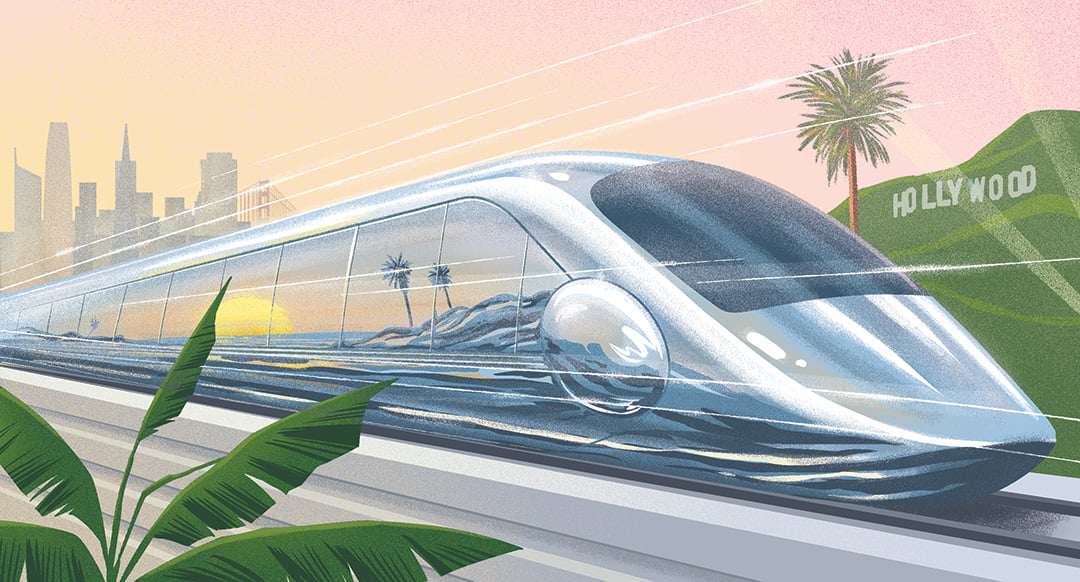
“We’re demonstrating that California isn’t waiting for the future. We’re building it.”
Governor Gavin Newsom
California high-speed rail was first proposed in 1979. Plans inched forward until 2008, when 53 percent of California voters approved Proposition 1A, allocating $9.95 billion to the project. Some funds have already gone toward rail infrastructure improvements in L.A. and the Bay Area, including the electrification of Caltrain tracks between San Francisco and San Jose — making them, Terplan says, “high-speed rail ready.” Funding remains the biggest issue. The rail authority still isn’t fully financed, but it can count on $1 billion a year from California’s cap-and-invest greenhouse-gas-reduction program, recently extended through 2045, and is seeking a major private investment partner this year. Building in phases creates its own risks. “I’m a little bit concerned,” says Giovanni Circella, the director of the 3 Revolutions Future Mobility Program at UC Davis, “because potentially the ridership results from the first phase might not be very successful.” Disappointing numbers from a stretch of track that bypasses L.A. and the Bay Area could fuel a public backlash. “That makes it easy for people who are not supporting the project to say, ‘We told you this is a waste of public money,’ ” he says. Terplan counters that incremental building is hardly unique to rail — many highways, including Interstate 5, were built over decades.
The rail authority’s $14 billion in spending has already generated $25 billion in economic benefits through job creation and materials purchasing. The train’s route through Fresno and Bakersfield — the state’s fifth- and ninth-largest cities — could unlock what planners call a “corridor of opportunity.” The goal is walkable urban environments built around housing, retail, education, and innovation, particularly in ag-tech and bio-industrial manufacturing, sectors where the Central Valley already leads. Circella cautions that such investment doesn’t always follow the tracks, pointing to French secondary cities that gained high-speed rail connections but failed to attract the hoped-for development.
But the most immediate benefit may be simpler: giving Californians a genuine alternative to cars. Without one, Terplan says, “people are subject to the whims of what gas prices are doing to them.” High-speed rail could ease pressure on the state’s strained freeway system and airports, many of which are already at capacity. Circella points to Italy, where high-speed rail between Milan and Rome — also built in phases — eventually displaced short-hop air travel significantly. “Today the major solution to travel between these cities is the train. Now other cities complain they don’t have high-speed rail.”
Beyond Phase 1, the vision expands considerably. Further extensions would bring high-speed rail south to San Diego and north to Sacramento, connecting California’s major population centers. There is also the prospect of linking with Brightline West, the privately funded high-speed line currently under development between San Bernardino County and Las Vegas. This would effectively make the Southwest a single interconnected fast rail corridor. For urban planners, the longer-term prize is what happens around the stations: the kind of dense, walkable districts that have transformed the areas surrounding high-speed rail hubs in Japan, France, and Spain. “High-speed rail is in some ways the best manifestation of a vision to fundamentally integrate and connect California in a way that sets the state up for a better economic future,” Terplan says. The skeptics will point to the delays, the cost overruns, and the decades still to come. But as Terplan puts it, “There’s no place in the world that has built high-speed rail that regrets it.”
This story originally appeared in the Fashionable Living 2026 issue of C Magazine.
Discover more CULTURE news.
See the story in our digital edition