
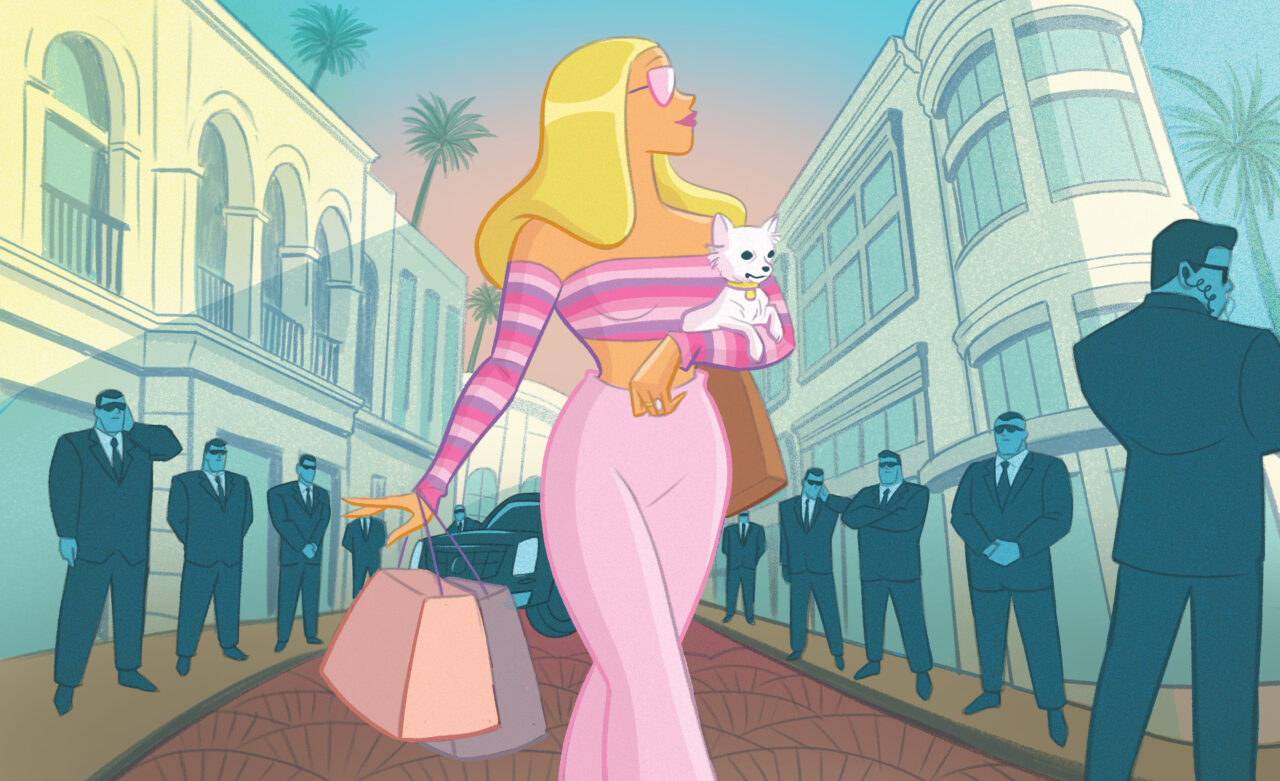
In neighborhoods across the state, fortified homes and round-the-clock surveillance signals status
Words by STEVE SANDERS
Illustration by DEREK CHARM
Jenny Letts first noticed them on her morning walks: multiple black SUVs parked on her quiet street in Berkeley. She also noticed the men — beefy and stone-faced in tight-fitting muscle tees and sunglasses. They trailed her neighbor Bill every time he left his home. For most of his life, Bill was an academic, but then he started an artificial intelligence company. It did so well that Bill became a billionaire, which meant he was also a target. He hired 24-hour security.
Bill, whose name has been changed to protect his identity, is not alone. In the wake of the public murders of political activist Charlie Kirk and United Healthcare CEO Brian Thompson, demand for private security for high-net-worth individuals has skyrocketed. Dino Zografos, a 36-year veteran of the San Francisco Police Department who worked in special operations before retiring six years ago, said his company, Spartan International, has seen demand explode over the past year.
“A lot of it is companies telling their executives, ‘You need this. It’s not a choice,’ ” he says. “Unfortunately, it often takes this public loss of life to get people to act.” Bill Rigdon, the founder of Panic Room Builders, which specializes in constructing safe rooms for the ultrarich has never been busier.
Safe rooms can range from $100,000 to $1 million. On the pricier end, bank-style safe doors can be disguised to look like any other room entrance, or a false bookcase can hide a door that is opened by pulling on a specific book. A door handle can be electrified to jolt anyone who grabs it, and pepper spray jets are ready to blast intruders. Inside, safe rooms are often outfitted with drinking water, food, medications, firearms, and chemical toilets (installing plumbing in an armor-clad room can be tricky). “People have to have everything they need for a sustained period of time,” Rigdon said. “Response time on those narrow streets in Beverly Hills could take hours if there’s a fire or a garbage truck in the way.” He is outfitting mansions from Los Angeles to London with safe rooms at an unprecedented rate.
A recent analysis by the Financial Times revealed that 10 tech companies, including Amazon, Apple, and Meta, spent $45 million last year protecting their executives. That number reflects a small portion of the picture. The AI boom has turned previously anonymous executives, like Bill, into centimillionaires. Either by choice or company mandate, they suddenly find themselves surrounded by bodyguards and being hustled from one event to the next in SUVs that may be outfitted with an array of James Bond–level countermeasures.
Typically, armored cars are Chevrolet Suburbans or Cadillac Escalades because General Motors will build them with reinforced frames and braking systems, plus bigger engines to account for the extra weight of armor plating and inches-thick bulletproof glass. Some are outfitted with a smoke screen system that can be switched on to confuse pursuers, as well as razor spikes dropped from a box under the vehicle. “If you dump those on the road, the bad guys aren’t going anywhere,” Rigdon said.
“Companies are telling executives, ‘You need this. It’s not a choice.’ ”
dino zografos
Security can take many forms. James Hamilton, a former FBI agent and the founder of Hamilton Security Group, said it typically starts with a vulnerability assessment that encompasses the safety of a home or workplace, the route to work, cyberthreats, and the profile of the client. This review can cost $12,000.
For someone like Elon Musk, who said last year that “two homicidal maniacs in the last roughly seven months came to aspirationally try to kill me,” something akin to presidential-level security might be required. This means house-hardening measures, such as installing bulletproof windows and doors, cameras, motion sensors, and industrial-locking systems you might see in a bank or a jewelry store. It would also likely include multiple armored cars and 24-hour bodyguard protection. The price tag can easily exceed $10 million annually. Last year Meta paid $27 million to protect Mark Zuckerberg and his family as they traveled among their homes in the Bay Area, Lake Tahoe, and Hawaii.
Reid Hoffman, the tech billionaire and prominent Democratic Party donor, recently put on an annual tech conference in San Francisco where he was flanked by security at all times. German shepherd and Labrador retriever sniffer dogs patrolled the grounds and guards with tactical vests and walkie-talkies stood sentinel on rooftops at the event, all because of its leader.
On the other end of the spectrum, people can opt for simpler measures. Installing a basic panic room can cost at least $25,000, Hamilton said. Short of that, he can offer training to individuals who don’t want around-the clock guards. “I’ll teach them situational awareness, listening to their intuition, where attacks happen, how to lose a tail, what to do if confronted,” he said. “It’s be-your-own-bodyguard type of stuff.”
One reason for the surge in demand is changing public attitudes. In a YouGov poll conducted in June, after Minnesota lawmaker Melissa Hortman and her husband were shot and killed at home by a stalker posing as a police officer, 14 percent of respondents said political violence was justified. “We’re in a place now where some people are celebrating the Kirk killing. High-net-worth people are seeing that folks in America — not everybody, but a lot — are fine with just killing a guy for nothing more than speech. That’s very, very serious,” Hamilton said. “They look at it as, I need protection and I need it more than I probably ever have needed it in the past.” In the affluent neighborhood of Encino, the Los Angeles Police Department deployed horseback sheriffs to patrol the streets after a series of break-ins.
Of course, no measure is guaranteed to stop a determined bad actor, especially a sniper, as in the case of Kirk. The key, said Zografos, is to slow down the aggressors or simply make it harder for them. “Making them think twice, buying time, is key,” he says. “If your house is hardened, for example, it gives you more time for help to arrive.”
The security boom has also led to a flowering of less reputable operators in an industry with no real standards. Although some providers are highly professional and steeped in law enforcement training, others are less skilled or trying to turn a quick buck. “They all expect us to be like John Wick. And some guys really look the part but just don’t know what they’re doing,” Zografos said. “I called them the bullet catchers.”
Many well-to-do people settle into having a consultant. After a threat assessment, house hardening, or other measures, a family or an individual will hire a provider on retainer, “like a doctor,” Hamilton said. “I do that a lot. Clients call me, we talk it through, and it’s an hourly bill. You can really help them with their anxiety and give them real, no-nonsense, practical advice. Because, man, at the end of the day, it’s always that question: How much imposition in your life are you willing to accept?”
This story originally appeared in the Winter 2025 issue of C Magazine.
Discover more CULTURE news.
See the story in our digital edition