Decades after reshaping daytime TV, Oprah Winfrey is back behind the mic with a new podcast. C pays a visit to the media titan in her Montecito idyll
Photography by KURT ISWARIENKO
Styling by ANNABELLE HARRON
Words by ROBERT HASKELL
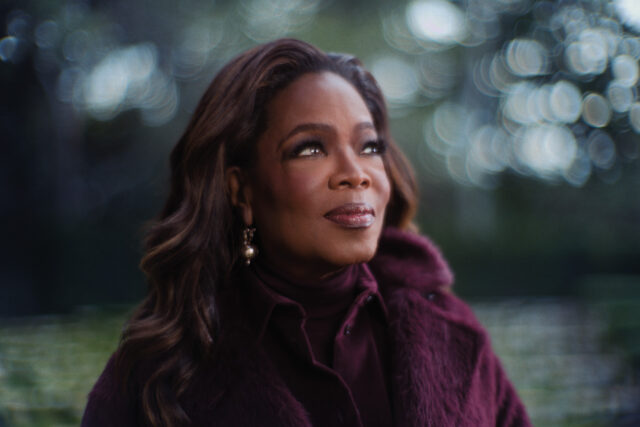
There’s a misconception about Oprah Winfrey. It’s so well known that it can hardly be called a misconception: that she is the ultimate people person, that her prodigious interpersonal gifts emanate from a desire to connect, above all, to her fellow humans. Not quite. Winfrey’s move to Montecito in 2001 was driven in part by a contrary impulse.
“The thing I cherished most,” she says, “was coming to a community where nobody wanted anything from me, where you could just go to the supermarket. And people would see you, and they’d be cordial and kind, but nobody was going to be asking you for anything. Nothing was required of me other than to be, and to be myself.” Still, she accepted the occasional invite. Winfrey also recalls a great ready-made circle of friends from the moment she bought the property. She remembers that first year as a succession of big outdoor dinner parties, a glittering welcome wagon with its many welcoming arms outstretched. But these days — the Bezos-Sánchez wedding notwithstanding — Winfrey is likely to decline. And she has no FOMO.
“One thousand percent no,” she says on a golden autumn afternoon on the patio of the house, which she calls the Promised Land. As always, she has spent much of the day outdoors, in the shadow of her beloved redwoods and oaks, and her watch indicates that she has already hiked 5.18 miles. “My secret is that I’m most comfortable with myself. My other secret is that although I appear to be extremely extroverted, and I have developed extroverted tendencies that let me function in the world, I am majorly an introvert. The best time in the world for me is if there’s a big storm. I am happiest either under my trees or building a fire when the fog comes in.”
“My mantra is, Life is better when you share it.”
OPRAH WINFREY
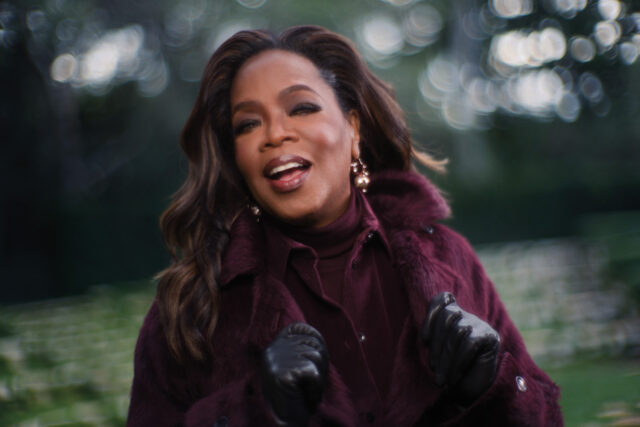
But Winfrey, 71, keeps busy. Late last year, eager to continue her decades-long project of introducing, through conversation, the ideas of important thinkers to a larger audience, she started The Oprah Podcast. “All my podcasts are little teachings,” she says. “Little drops of light for people to see themselves in a way that they need reminding of sometimes, or that reminds them of the goodness in themselves. That’s why I decided to do it. I’m sitting at my table with Father David or Eckhart Tolle, and I’m like, ‘God, I wish everyone could hear this.’ My mantra is, whether it’s a sandwich or a great experience or a trip or whatever, Life is better when you share it. So to have these conversations is a way for me to share information in a way that I think will benefit people.”
Winfrey is, frankly, worried about the world. She worries about the way in which social media and device use have rendered a generation of children and adolescents ill equipped to interact with the real world. She worries about government incursions into free speech. “I don’t think there’s a level of awareness of how dangerous it is,” she says. “People not understanding that if Jimmy Kimmel can be taken off the air, it’s not long before they’re coming for you. I don’t know if The Oprah Winfrey Show could exist in this environment. I would be in trouble every day because I feel that in order to actually speak the truth and speak your mind, somebody is going to be offended.”
Although she used to watch the news every evening, Winfrey has lost the stomach for it. “I really can’t ingest it,” she says. “I have to modify how much negative information I allow myself to take in. And I moderate it. I’ll scan my iPad for what I actually need and not take in the rest.” The Atlantic got her through the pandemic and beyond, and she still reads The New York Times and The Guardian. She believes that the single greatest safeguard as she confronts the media landscape is that she can separate right from wrong. She is not afraid of any algorithm. “I actually feel that I have a great sense of discernment about what is the truth and what isn’t,” Winfrey says. “An algorithm isn’t going to change my value system.”
The Kimmel affair reminded her of what happened some 30 years ago, when she aired a show devoted to the topic of “dangerous food.” She said on air that she had decided to stop eating hamburgers after learning about the risk of mad cow disease. Her comment led to a significant drop in beef prices, and members of the Texas cattle industry sued. The jury ruled unanimously in Winfrey’s favor. “On the day I won the trial,” she says, “the first thing I said was, ‘Free speech rocks.’ For democracy to continue to be what we want it to be, you have to have free speech. So I was very happy to see that Jimmy Kimmel was restored to his position on ABC. Regardless of whether you agree or disagree with him, he has the right to be disagreed with and to be agreed with.”
“I have a great sense of the truth. An algorithm isn’t going to change my value system.”
OPRAH WINFREY
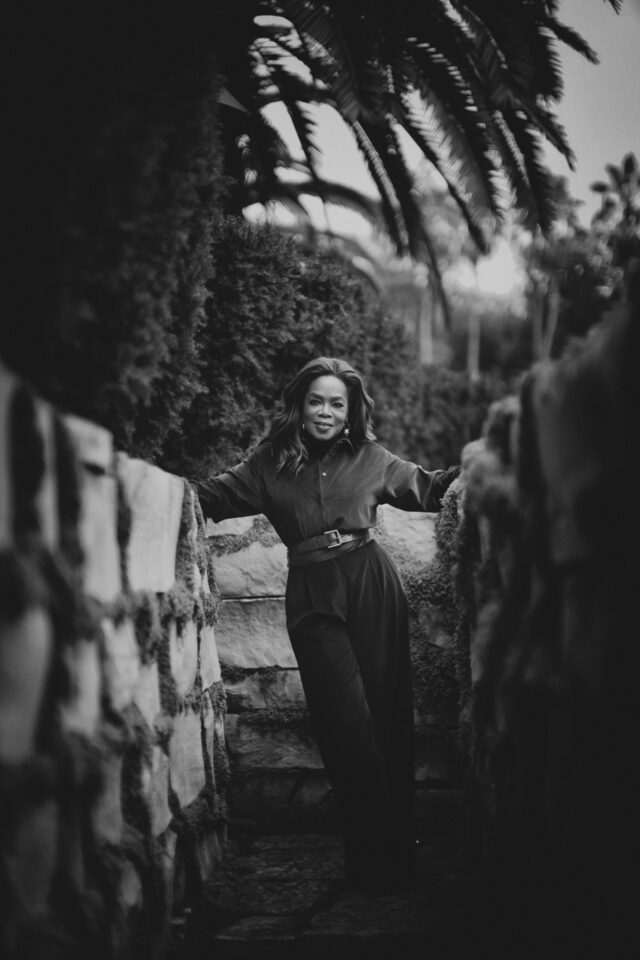
Inevitably, she also worries for the environment, which has continued to batter her beloved home. Her relationship to Montecito changed forever in 2018, when a wave of mudslides tore through the Santa Ynez Mountains and took apart the town, killing 23 people. Winfrey was home and remembers gazing out at a night sky turned orange when a giant boulder carried by the debris flow hit a gas main and started a fire. “At the time, President Trump had been talking to Kim Jong Un, and I thought, Oh my God, we’ve been nuked,” she says. “I remember hesitating, thinking, I’m going to go out on the porch and I’m going to disintegrate. I said to Stedman [Graham, her long-time partner], ‘Wake up! The sky is orange!’ And he got up and looked at me, and he goes, ‘Nothing I can do about it.’ That was the beginning of my deeper connection to the community and a greater sense of appreciation for the people who live here.”
In times that feel perilous, Winfrey says she keeps her head by returning to nature, which she calls “the center of myself.” The wild of her own vast backyard has been a buffer against the noise of the wider world. And she has never felt healthier, thanks to knee-replacement surgery and a combination of walking, hiking, weight training, and GLP-1 medication, of which she has been an early and potent champion.
“Let me just say for myself, who suffered from the disease of obesity long before I knew that it was a disease: It is a revelation,” she says. “It is a miracle that I no longer have to struggle with believing that it was my lack of willpower that continued to put the weight back on again and again. I have been shamed — was ashamed of myself — been blamed, blamed myself. Never thought that there would be a solution in my lifetime. It has completely shifted the way that I see myself in the world. It shifted my attitude toward going places, doing things, being active, participating in things I never would have participated in — all of it. Because I’m not in the struggle.”
Born in rural Kosciusko, Mississippi, in 1954, Winfrey was initially raised by her grandmother on a small farm without running water. She learned to read by age 3 and began reciting Bible verses in local churches, foreshadowing her aptitude for language and command of an audience. Despite moving between her mother’s home in Milwaukee and her father’s in Nashville, she excelled academically. By 19, she had become the youngest and first Black female news anchor at WLAC-TV in Nashville, balancing her broadcasting ambitions with studies at Tennessee State University. In 1976, she moved to Baltimore to coanchor the evening news, and she became known for her empathetic approach, which became her signature when she took over AM Chicago (a struggling morning talk show) in 1984 and transformed it within months into The Oprah Winfrey Show, a national phenomenon that redefined daytime television. Over 25 years, Winfrey built a media empire, including Harpo Productions, the OWN network, and O Magazine. Her accolades include a Presidential Medal of Freedom, an Oscar nomination for The Color Purple, a book club that turns 30 next year, and the distinction of becoming the first Black female billionaire in North America.
Winfrey’s philanthropic legacy rivals her media empire: She has donated more than $400 million to causes spanning education, equality, and disaster relief; founded the Oprah Winfrey Leadership Academy for Girls in South Africa; funds hundreds of college scholarships; and rebuilt homes after Hurricane Katrina. She continues to support multiple causes, championing opportunity as the truest form of empowerment.
“I am happiest either under my trees or building a fire.”
OPRAH WINFREY
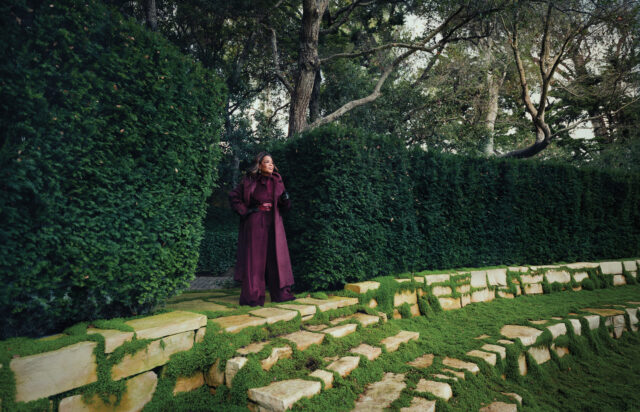
In this next decade, Winfrey intends to stay open to projects that, she says, “bring humanity together.” She wouldn’t mind interviewing Pope Leo XIV and is hopeful that their shared connection to Chicago might give her an in (as if she needed one). Despite exhortations to do so, she has no wish to run for office. “I couldn’t jump into that pool,” she says. “That’s not a pool I want to be in.”
Although she does not long for yesterday, she misses the power that her show had to shift the cultural conversation. A long time ago, in a grocery store, a woman stopped her and told her that at first she didn’t believe Winfrey when she advised parents not to hit their children. “It’s one of my favorite moments,” she says. “We used to do a lot of shows — big debates on spanking. This was the ’80s and ’90s. And this mother says, ‘I used to see you talk about how you’re not supposed to hit your kids, and I didn’t believe you, because how are you going to have good kids if you don’t hit them?’ And she said, ‘It wasn’t the fact that you said it. It was the fact that you were consistent, and every time you talked about it you were consistent. So I stopped hitting my kids. And I have different kids. And I’m a different mom.’ That just stuck with me. It’s not about saying something one time. The show was able to say something and say it again until it was a part of the culture.”
But few things in Winfrey’s life have been more consistent and nourishing than her relationship with her home. She walks the property nearly every day, and every day she finds something new, sees the light brighten a familiar tree in a different way. “Every day it feels different to me,” she says. “Every day I find something to feel a sense of awe about. And what I most feel — where I most get the feeling of awe — is sometimes crossing the bridge. Looking up through my backyard to my house, I am just amazed that I came from a dirt road in Mississippi to Montecito. I am ah-mazed at that. Capital amazed, as in amazing grace. California — it feels like God did some of his best work here.”

Hair by NICOLE MANGRUM.
Makeup by ADAM BURRELL at Opus Beauty.

Feature image: MAXMARA long coat, $6,025, bodysuit shirt, $930, turtleneck jumper, $625, trousers, $930, belt, $470, gloves, $365, and earrings, $590.
This story originally appeared in the 20th Anniversary 2025 issue of C Magazine.
Discover more CULTURE news.
See the story in our digital edition