
In a city defined by reinvention, the interiors virtuoso and furniture designer sit down to discuss craft, collaboration, and how one generation of L.A. designer is shaping the next
Photography by RAINER HOSCH
Words by ELIZABETH VARNELL
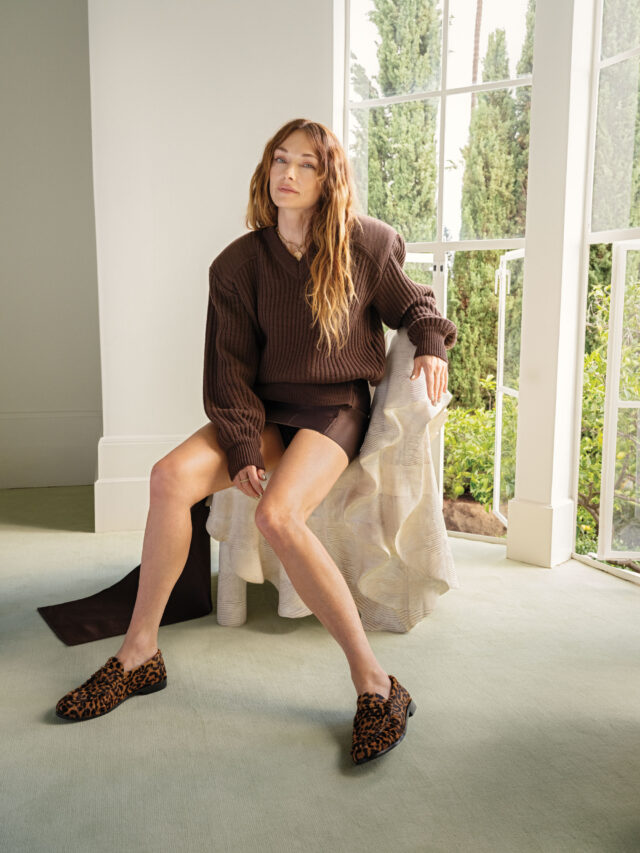
Sam Klemick sees wood as a textile. The design furniture and objects she creates in L.A. have the smooth curves of cloth honed through sculpting rigid planks, revealing her roots in fashion as a knitwear designer. “I have a very intimate and personal relationship with fabric,” says the Miami native, who studied at FIDM and logged years at Rag & Bone. Klemick’s background in a notoriously unsustainable industry makes her particularly averse to waste and informs her furniture practice. She relies on deadstock materials for upholstery and reclaimed wood to cut and carve. While Klemick was newly immersed in her second career, the telltale elegance of her furniture caught the eye of interiors virtuoso Kelly Wearstler, just as it captivated the organizers of the London Design Fair, New York’s Objective Gallery, Alcova Miami, and the Patricia Urquiola–chaired Haworth DesignLab at NeoCon.
“You think you’ve seen them all, and then some new raw talent surprises you.”
kelly wearstler
Wearstler’s decades-long career, filled with boundary-pushing California houses coupled with her role in launching the designer hotel era, has changed the look of American design. She and her studio have commissioned work from artists like Klemick for projects over the years, and Wearstler wanted a way to continue the dialogue. “It’s been a dream to have a curatorial platform to work with them,” says Wearstler, who relishes the process of collaborating and watching artists experiment with new or different directions. This is the genesis of Side Hustle, a series of partnerships with creatives whose made-to-order pieces are sold in editions. When Wearstler, known for her bold, expressive eye, looked for artists to include in the first launch, she thought of Klemick. As they prepped a four-piece collection comprising a sculptural chair, a side table, a mirror, and a lamp Klemick devised from reclaimed Douglas fir for the drop, the two women sat down for a conversation about the art world, power tools, and the spirit of creativity in L.A.
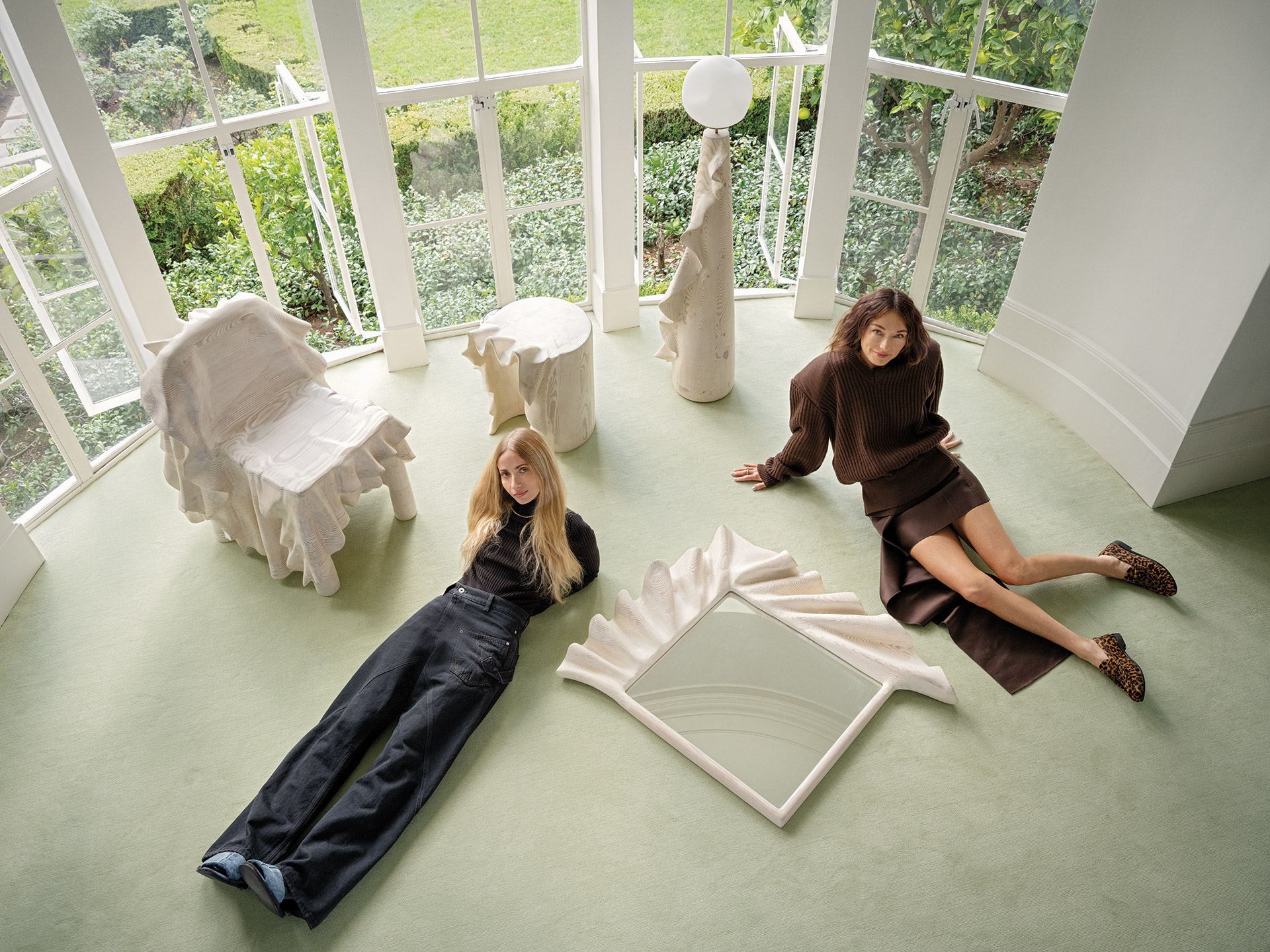
Kelly Wearstler: You’re a female working in timber, which is really unique. We were introduced through Instagram, and you really stood out. I also love that you’re in L.A. We have to represent our beautiful city.
Sam Klemick: I actually first learned about you when you were a judge on Top Design years ago, and I remember thinking, This woman can dress. In our first meeting, we talked about your love for fashion, my background in it, and you pulling from your wardrobe because I work with clothes and fabric. It all felt really organic.
KW: The idea of using clothes as a starting point to design the furniture really came from a conversation, just sitting around a table. I’m such a big believer in having a great discussion.
I realized I had the perfect Emanuel Ungaro dress from the 1980s from a vintage fair in New York. I wore it for a photo shoot, but I haven’t gone anywhere in it. I’m going to Performa [the biennial New York festival of performance art], so maybe I’ll wear it for the gala.
SK: You have to. It would be perfect. Where else do you go for art?
KW: I go to galleries and museums — the established, the emerging, all of them. When I travel, I make time for galleries. I go to Frieze in the different cities, and Zona Maco, founded by Zélika García, in Mexico City. What about you?
SK: Art Basel, Design Miami, openings at Hauser & Wirth, Rhett Baruch Gallery — Marta gallery is a big one for me. I also love Carpenters Workshop Gallery and Friedman Benda. There are so many accessible, collectible galleries in L.A.
KW: So many. When I moved here there were galleries, but now they’re everywhere. And the emerging galleries have such a great point of view. The landscape is really diverse. It’s grown into something quite beautiful and important globally.
SK: Back to being a fashion nerd. The dress has pleating, circle-cut ruffles, ruffles that are sheared in. It has all these techniques within one dress that are really beautiful. I brought it home and laid it over a chair. Just looking at the way the back of the dress was draped, it was instant; it was so sculptural. It’s taffeta, so it holds the structure. I started sketching, and in my head there was an idea that Kelly is at a party and a ruffle falls on a chair, on a lamp, on a mirror.
KW: You start on the piece, and you step back and continue to work on it.
SK: Once we decided on sketches, I created the whole collection out of fabric. Then I made bases at the wood shop and draped everything in fabric to get a more to-scale 3D model. I don’t know how to 3D model on the computer, but I know how to drape fabric on a dress form. So I created my own furniture forms and 3D scanned all the fabric drapes so it’s not total freehand carving. Creating with fabric first is important to me — that it’s not just modeled on a computer.
“My work is pretty feminine. I love that it looks soft but is made from something hard.”
SAM KLEMICK
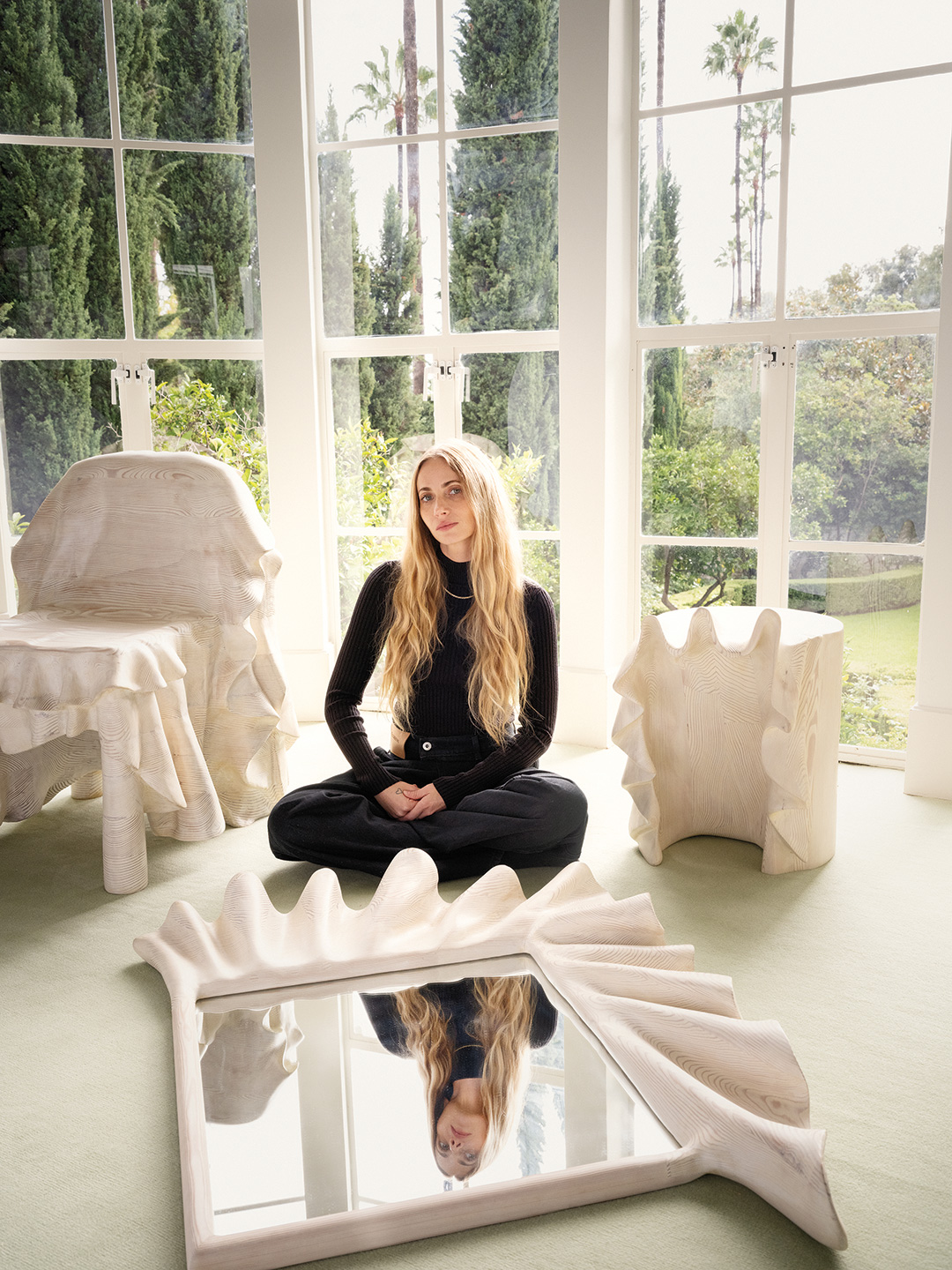
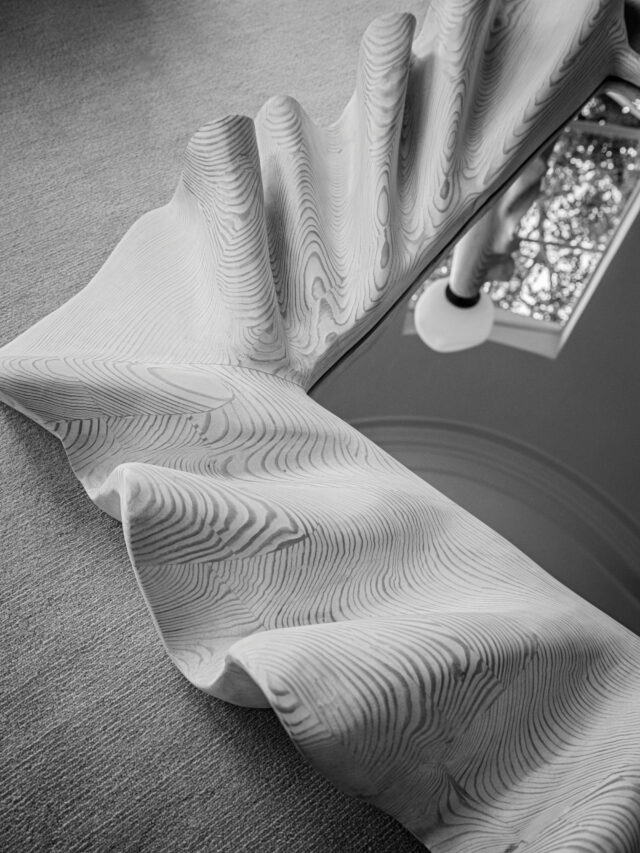
Next, I prepare the wood. This is all reclaimed Douglas fir from demolition on construction sites in L.A. Old-growth beams get salvaged, but I remove all the nails and screws. It takes hours; it’s a labor of love. I mill the lumber, square it, and start to cut it. The pieces are created by stacked lamination. That’s how we sandwich the pieces together and get this large form.
KW: And everything is functional — a lamp, a table, things at different scales that are appealing for different reasons. Sculptural but functional. This work is free-spirited. A lot of galleries focus on art that is sculpture or wall works or video. But this curatorial platform we created crosses over — we have scent, music, performance art, and more. It’s just unfolding naturally. Emerging artists are so free. You think you’ve seen them all, and then some new raw talent surprises you.
SK: There’s this conversation of design versus art.
KW: It’s all art.
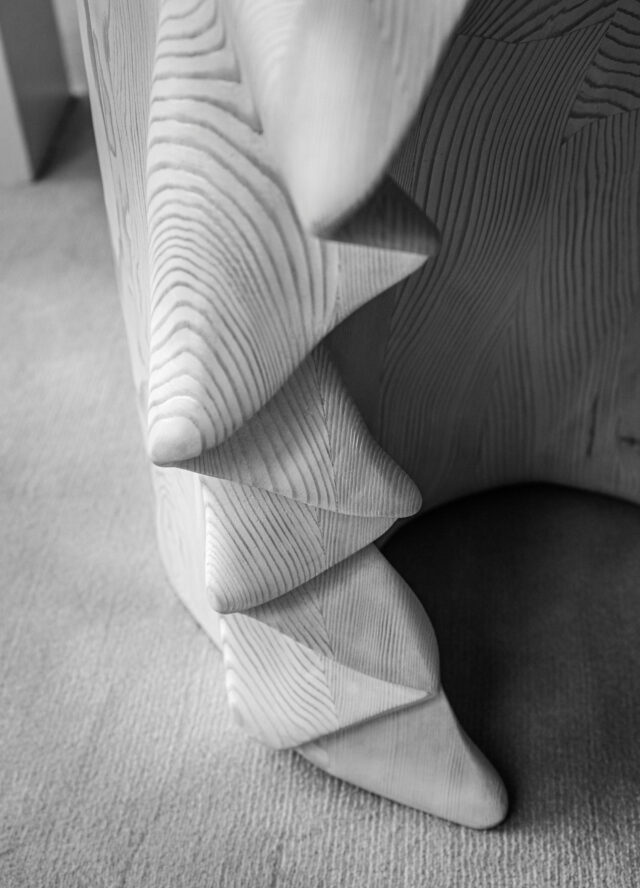
SK: I agree; it’s all art. We’re all creating things. And our art that we created for this also has a function. I don’t know that I’ve really thought too much about my work within the greater context of design. I’m still getting used to being in this world and having my work so visible. I guess my work is pretty overtly feminine. I’m not trying to make a point; it’s just what I’m drawn to. I’m trying to make work that genuinely comes from me and pulls from my background. I love that it looks soft but is made from something hard.
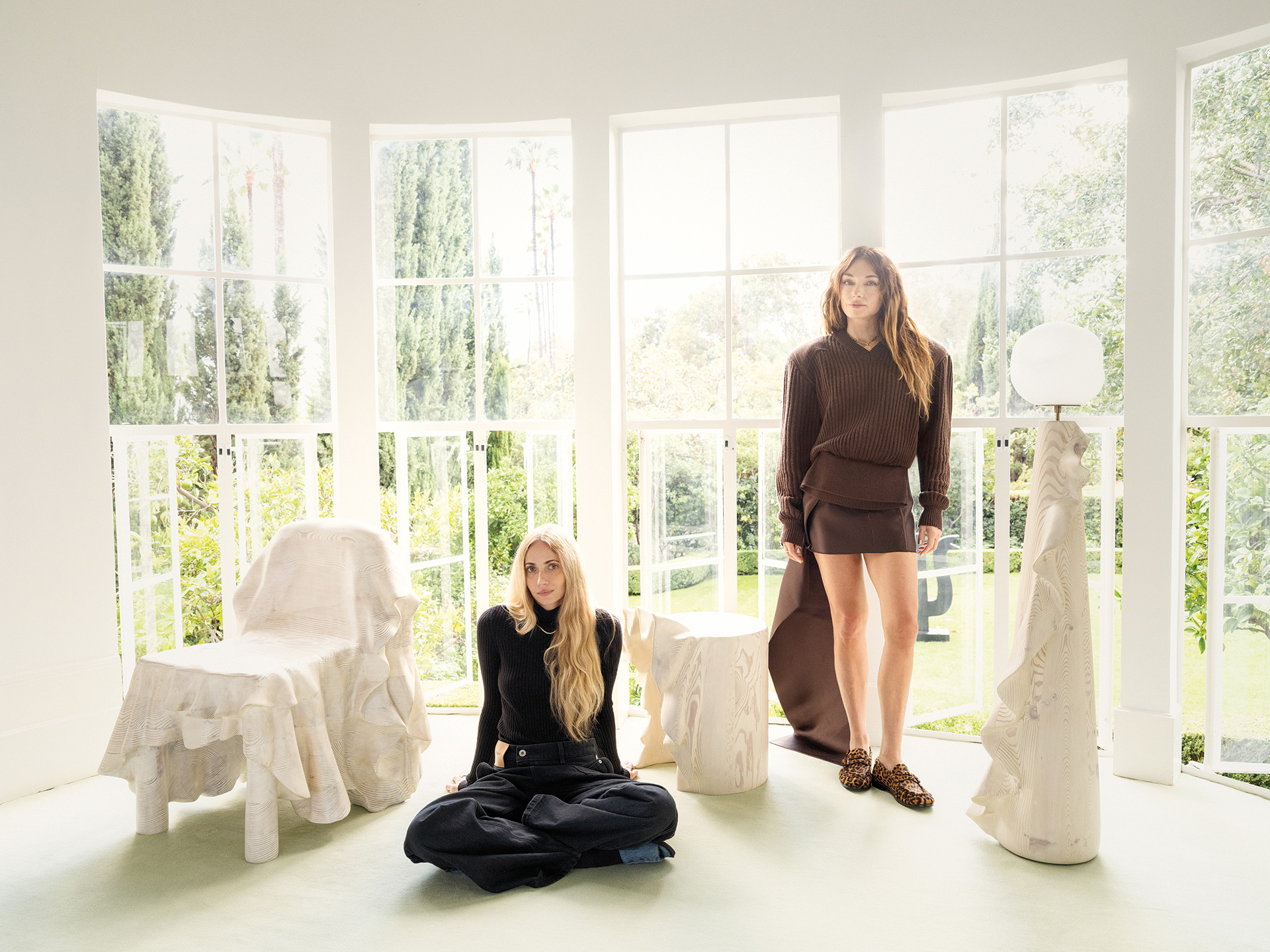
KW: There are more women artists today working in materials that are unexpected. If asked to describe your work, based on your personality, you might not think you’re working in timber. The pieces are very nuanced. If you look at the pedestal, the tapered structure, it’s a sculptural piece. Also, the glass was handblown, and all the metal components are burnished brass. Everything’s really considered. And with the timber, the [reclaimed] Douglas fir — you can speak more to this — it’s finding the best side. And everyone’s got a good side.
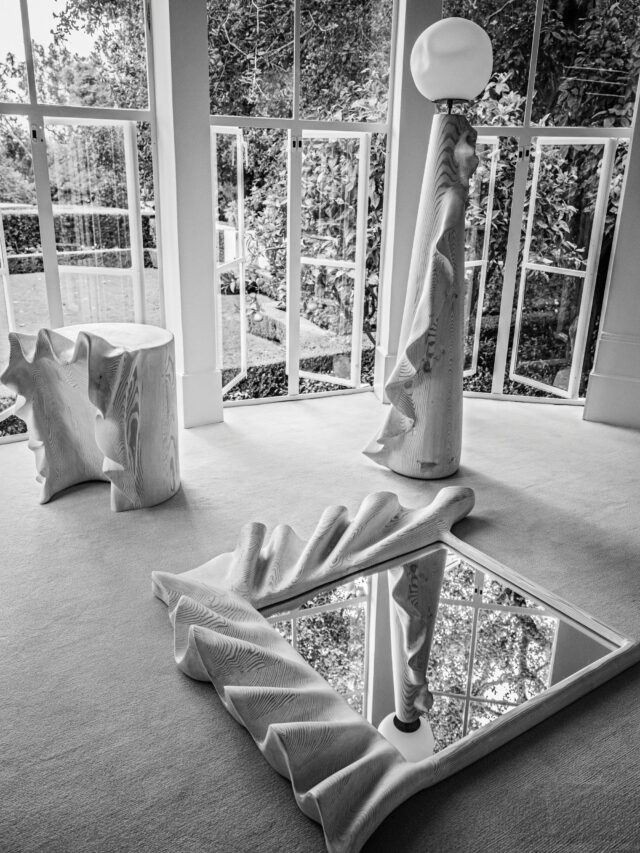
SK: The lamp has burnished brass. You wanted that finish. And a handblown glass globe created by Austin Fields, a glass artist based here. It’s wired by someone local in L.A. All this work is done by artists and friends. When I’m working on a sculptural piece, I’m at the shop every day. There’s so much invisible work. The sanding is insane. I probably don’t have fingerprints anymore. Even though it’s machine carved, there’s still a lot of hand-chiseling and carving, and then the whole finishing process. Kelly, you loved the idea of this bone finish. So I bleached the pieces and used a white wax. A lot of my work is very warm, naturally colored wood, but I also love whitewashed woods.
KW: It’s all finished by hand.
SK: You wonder if it’s marble.
KW: And now it’s here.
SK: The collection is called “Hollywood.” There’s a bit of a play on words. The source was this glamorous dress, a celebration of nightlife, and now these glamorous pieces of furniture.
KW: L.A. is a city of collaboration, and Hollywood represents this incredible convergence of creative minds. Naming the collection “Hollywood” felt like a nod to our shared city, to that spirit of imagination and creativity that defines L.A. and our work. sidehustlegallery.com.
This story originally appeared in the Winter 2025 issue of C Magazine.
Discover more DESIGN news.
See the story in our digital edition