After decades dressing the desert’s finest, the designer has created Soleil House, a colorful love letter to modernism that fully embodies her fashion philosophy
Words by BOOTH MOORE
Photography by LANCE GERBER
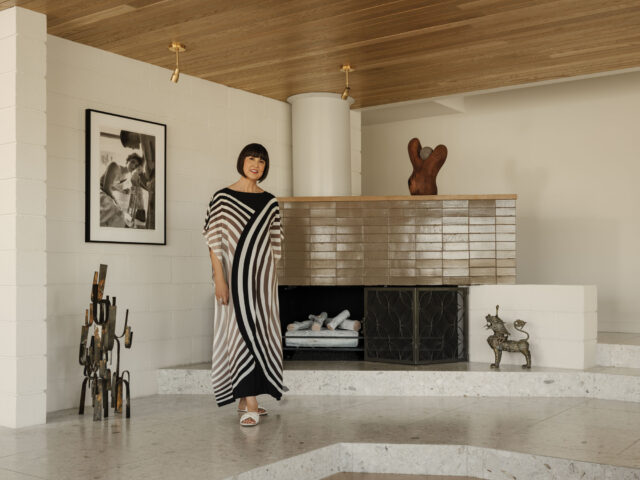
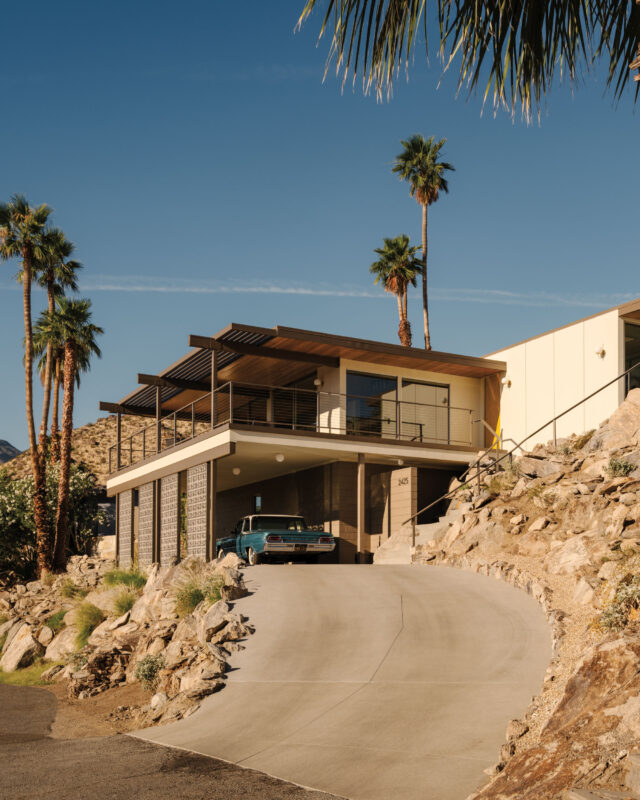
Perched among the red-brown rocks of the Cahuilla Hills, the decrepit 1963 relic had been vacant for years — its asymmetrical pool sitting empty, its windows obscured by debris. But when fashion designer Trina Turk started snooping around during the pandemic, she saw past the neglect to what would become Soleil House.
“We walked around the exterior, and you couldn’t even see into the windows because there was so much stuff piled up inside. But what you could see, especially from the far end of the pool, is the view, the lines, and the bones of the house,” says Turk, who has become a fervent preservationist, a board member of the Palm Springs Modern Committee, and a founding supporter of the Palm Springs Art Museum Architecture and Design Center.
For Turk, who is practically synonymous with Palm Springs after nearly three decades as a part-time resident, spotting diamond-in-the-rough modernism is second nature. The potent imagery of her sunny clothing in campaigns shot at architecturally important homes by Richard Neutra, Albert Frey, Craig Ellwood, and others helped bolster the image of the postcard-perfect destination and usher in an era of design-forward desirability.
She and her late husband, Jonathan Skow, became engrossed in Palm Springs modernism in the early 1990s, when they bought and restored their streamline moderne Ship of the Desert house. “All the interest in new construction had moved down valley, so Palm Springs was just sort of left here,” she says. “And, at the time, you could find these houses that had never been touched.” As Soleil House has proved, you still can.
Before she even knew the architect’s name, Turk could see the potential. So when the house went on the market in fall 2024, she bought it. While the crew was cleaning out junk from the basement, original plans surfaced and confirmed the designer was Harold J. Bissner, known for designing stately homes in San Marino and Pasadena before moving to the desert in the late ’50s, where he began working on more modern projects.
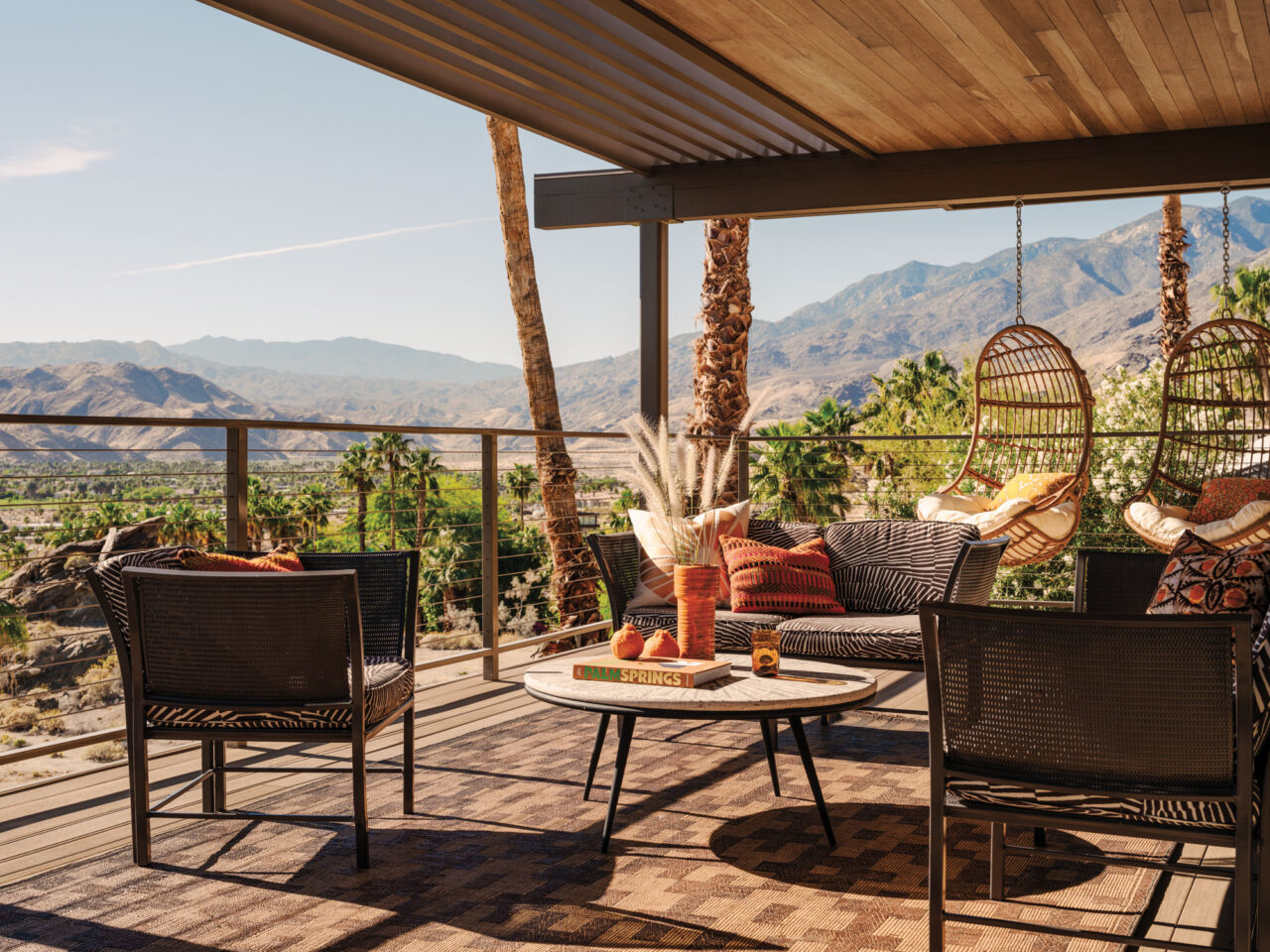
“I saw William Cody’s ceiling and I was like, ‘You know, it makes it feel warmer.’ So we ended up doing it on the outside decks.”
More important than the provenance, though, was the idea it sparked. Over the years, Turk had worked with home design partners such as Schumacher and Flor, but she never brought those collaborations together in one place. Soleil House would become her showcase. From the outset, that meant color. “There is a lot of beige decor out there,” Turk says. “There is a thing that’s happening where people buy midcentury homes, and they’re blowing out the walls and painting everything a really blinding white. The character and the intimacy are being lost. What I wanted to do was revive the house, hopefully maintain some coziness, and also express the true nature of our brand in a place that’s not a retail space.”
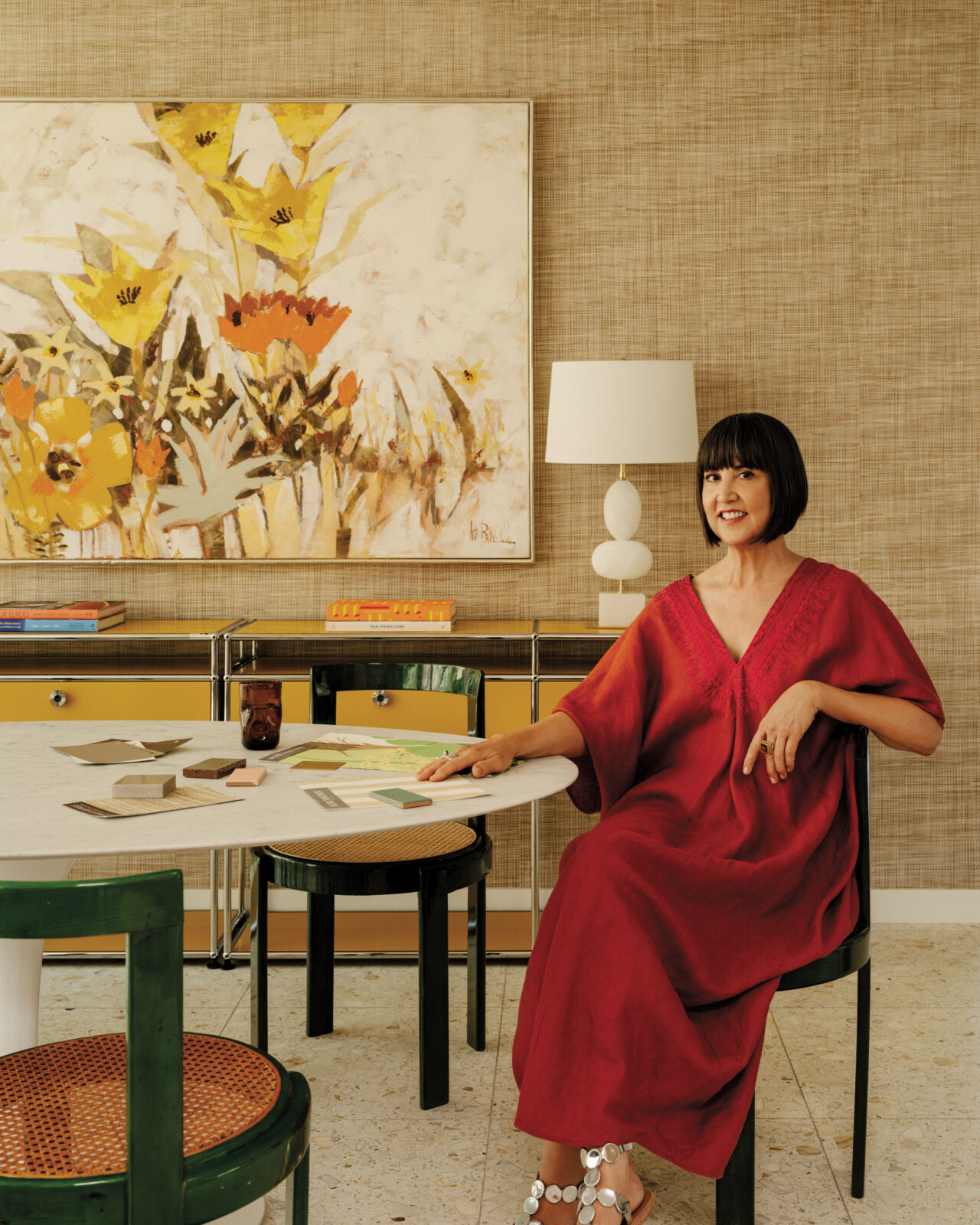
The inspiration for the mustard yellow, chocolate brown, soft turquoise, and aqua palette came early. One touchstone was an abstract mixed media Joseph Szeghy ’60s-era painting she found on Chairish. Another was Albert Frey’s 1964 Frey House II high above the Palm Springs Art Museum, with visual language that made a lasting impression. Turk was drawn to the way Frey’s interiors relate to the desert landscape: yellow draperies echoing brittle bush blooming on the hillside, turquoise corrugated metal ceilings “like a car finish…or frosted nail polish,” as she describes it, reflecting the vast sky.
By the time Turk bought the property, the hoarder house had been only minimally cleaned for sale, and the reality of the project set in. “The creatures had definitely taken over,” she says, showing photos of peeling walls, boarded-up windows, and overgrown landscape. There was a baby grand piano in the living room that she had to crane out. But she has restored homes before. “When we were redoing the Ship of the Desert, we had a huge fire. And when it was demoed down to what was salvageable, there really wasn’t much house left,” she says. “So I reminded myself of that experience and that this was going to be fun.”
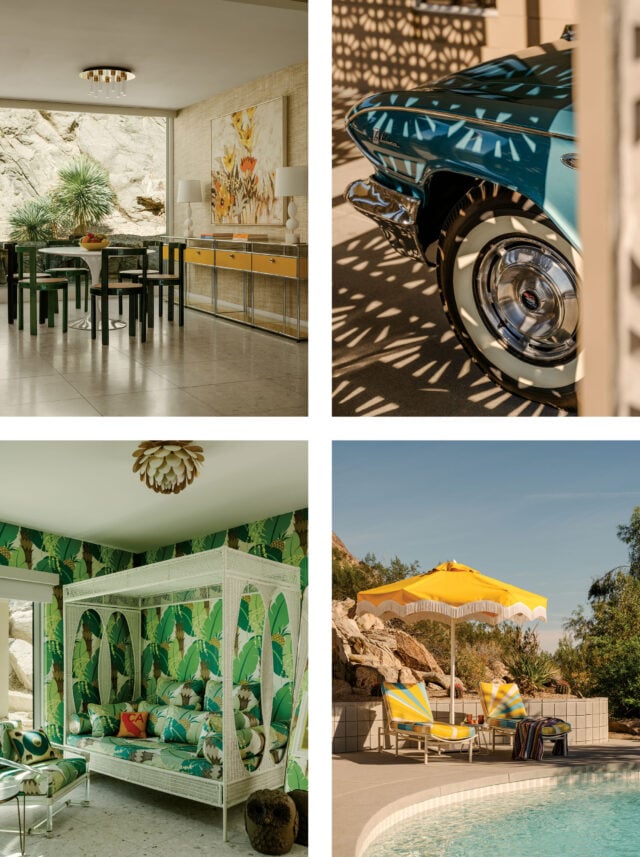
While building her business, she had noticed similarities between her fashion aesthetic and passion for modernism that guided her in taking the 2,300-square-foot house on two floors down to the studs, removing the layers and debris to get to the character as it was intended to be. “Modern architecture is about seeing the materials. They’re not covered with moulding and ornamentation,” she says. “What we do at Trina Turk is also very simple. There aren’t a lot of complicated styles. We choose interesting fabrics or create interesting prints and let them speak for themselves. The three words we use to describe our brand are color, print, and optimism. And I think modernism is also optimistic. All these houses were built after the Second World War. People were really excited about having this leisure lifestyle in the desert. So that’s also a connection.” It was the first time she had worked with hard materials, including designing custom Tesselle sunburst breeze blocks to enclose the carport, which offer a very Trina hello to those arriving at the top of the winding driveway. “It’s best in the morning, when the light is coming through,” she says of the sunny-shadow pattern play.
The house’s original layout reflected an era when kitchens were tucked away behind louvered doors and views sacrificed for family bedrooms, but Turk’s interventions brought the house into the rhythms of contemporary life. She removed a wall that was blocking one of the best panoramas and opened the kitchen with a new window onto the hillside’s dramatic sheer rock, sacrificing a bathroom to connect the room more fully to light, landscape, and guests.
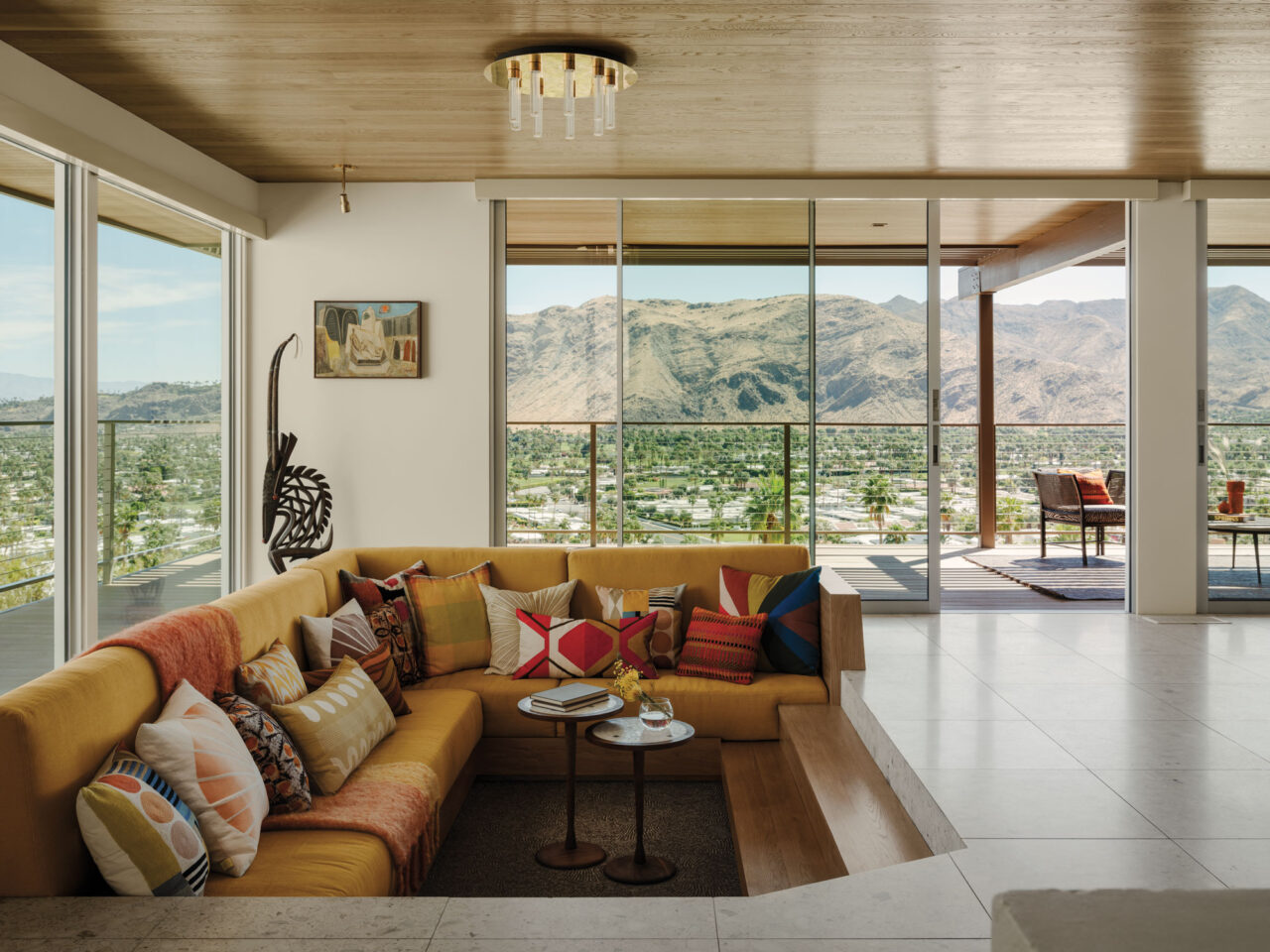
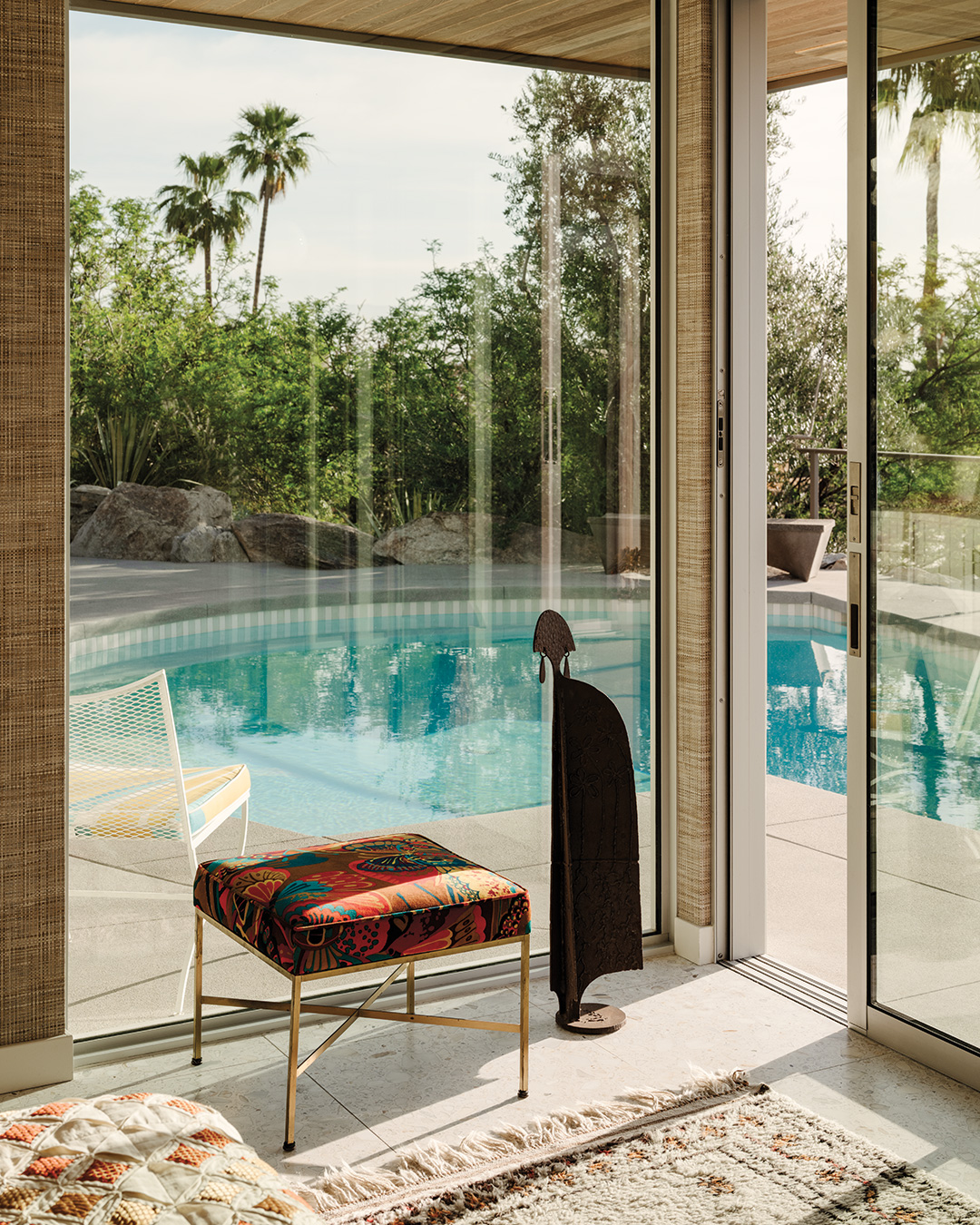
In the living room, she created a conversation pit — the most seductive midcentury gesture — which allows for a full view of the mountaintops. “I was channeling the Alexander Girard conversation pit at the Miller House,” Turk says, referring to architect Eero Saarinen’s collaboration with the prolific designer in Columbus, Indiana, in the mid-’50s, which started the sunken living room craze. She softened hers with yellow-linen-upholstered banquettes, Flor carpet tiles, and a scattering of Trina Turk embroidered and needlepoint pillows. It feels convivial rather than reverential, a place to settle into with martinis and view of the nearby fireplace, which has its original screen. The media room — or “snug,” as she calls it — was also carved out as part of the reworking of the floor plan, revealing the whole expanse of the valley through the sliding glass doors on the front of house. A study in textures, it’s furnished with a ’60s basket loveseat, shelves full of colorful glass bottles and decanters from Joe Cariati, and a hairy white bench purchased at FOG Design+Art. Touches like these, vintage pieces, and flea market finds keep the house from feeling like a period piece.
“I was channeling the Alexander Girard conversation pit at the Miller House.”
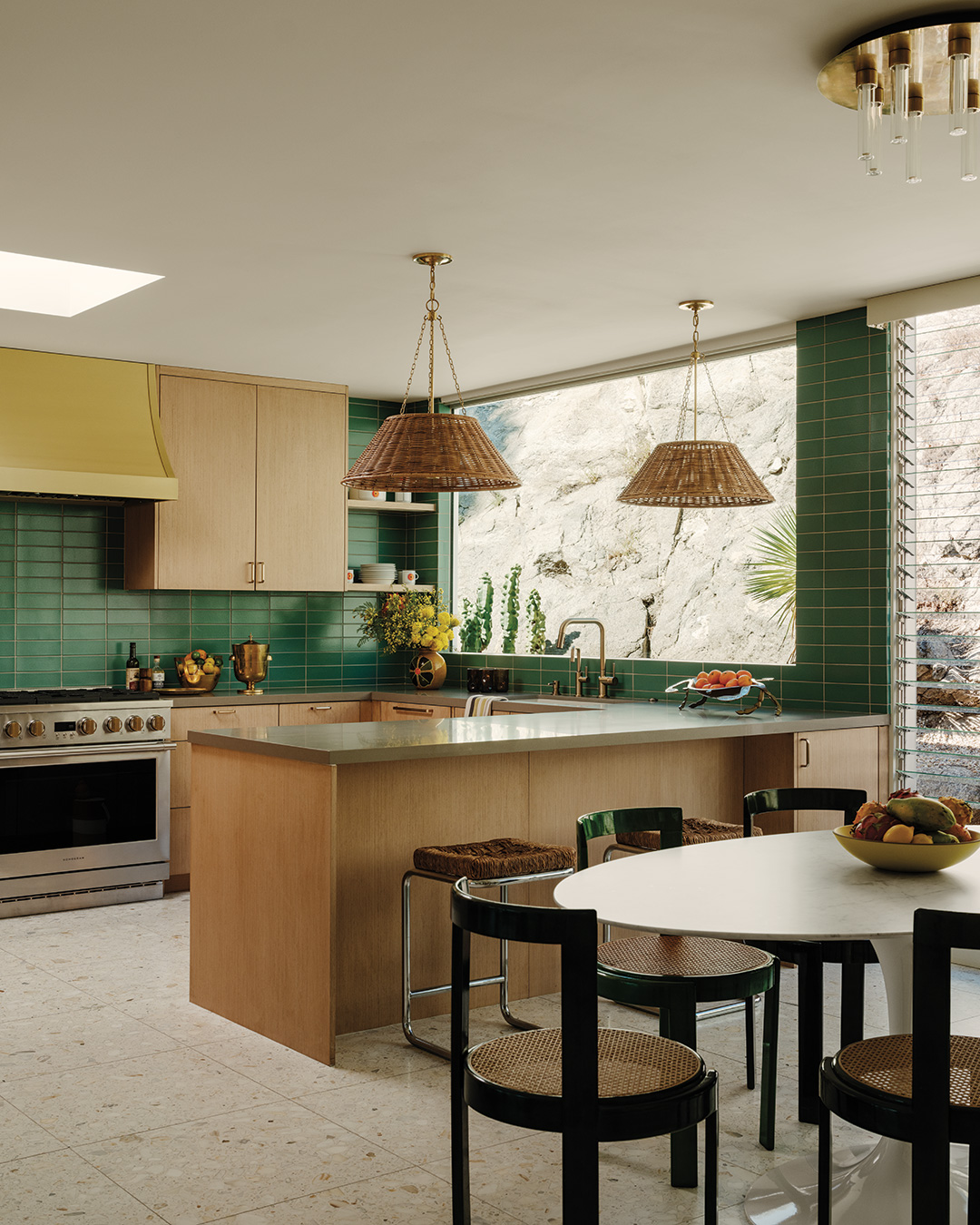
Across the board, Turk favored matte finishes. The Fireclay tile used in the kitchen and bathrooms eschew the glazed surfaces that were typical in the early ’60s. The same sensibility guided the choice of honed marble for the Saarinen oval dining table from Design Within Reach. “I didn’t want anything to be shiny,” she says. That decision gives the house a more casual, tactile sophistication.
That feeling is reinforced underfoot. Turk chose terrazzo floors, rich with honey and amber-colored stone, from Modern Home because they felt ideal for Palm Springs and materially right for the story she wanted to tell. In the primary bedroom, which has a view of the Bob Hope House, Turk leaned into pattern mixing with the confidence of someone who has built a career on making bold combinations feel effortless. Leafy wallpaper, a family heirloom quilt, layered Moroccan rugs, and colorful velvet cushions create a room that feels composed but relaxed.
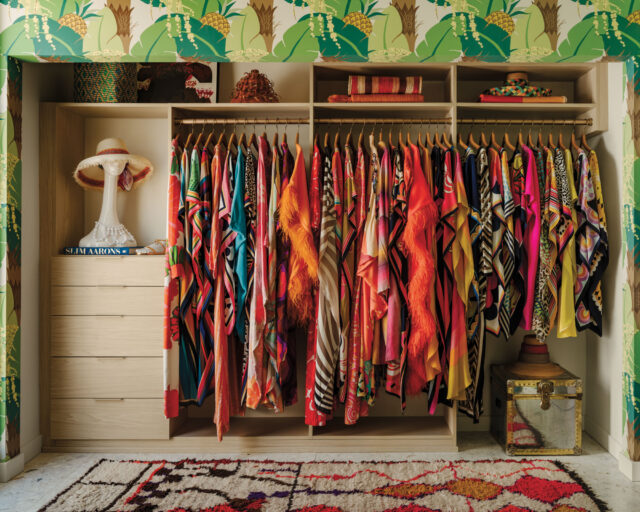
In the guest room, she removed a porthole window that was “just weird,” installing a sliding glass door. She also created shelves around the platform bed, which she decorated with old leather-bound books that had belonged to her father — and just happen to be in the right palette. Then there is the caftan room, the most overtly fashion-inflected space in the house. “A palm extravaganza” wrapped in Paul Poiret for Schumacher Ananas wallpaper, it features one of the earliest designers to expand from fashion into home furnishings, a relationship Turk clearly appreciates. The room features a vintage daybed piled with custom pillows in the same Poiret print, along with caftans from Turk’s collection and archive.
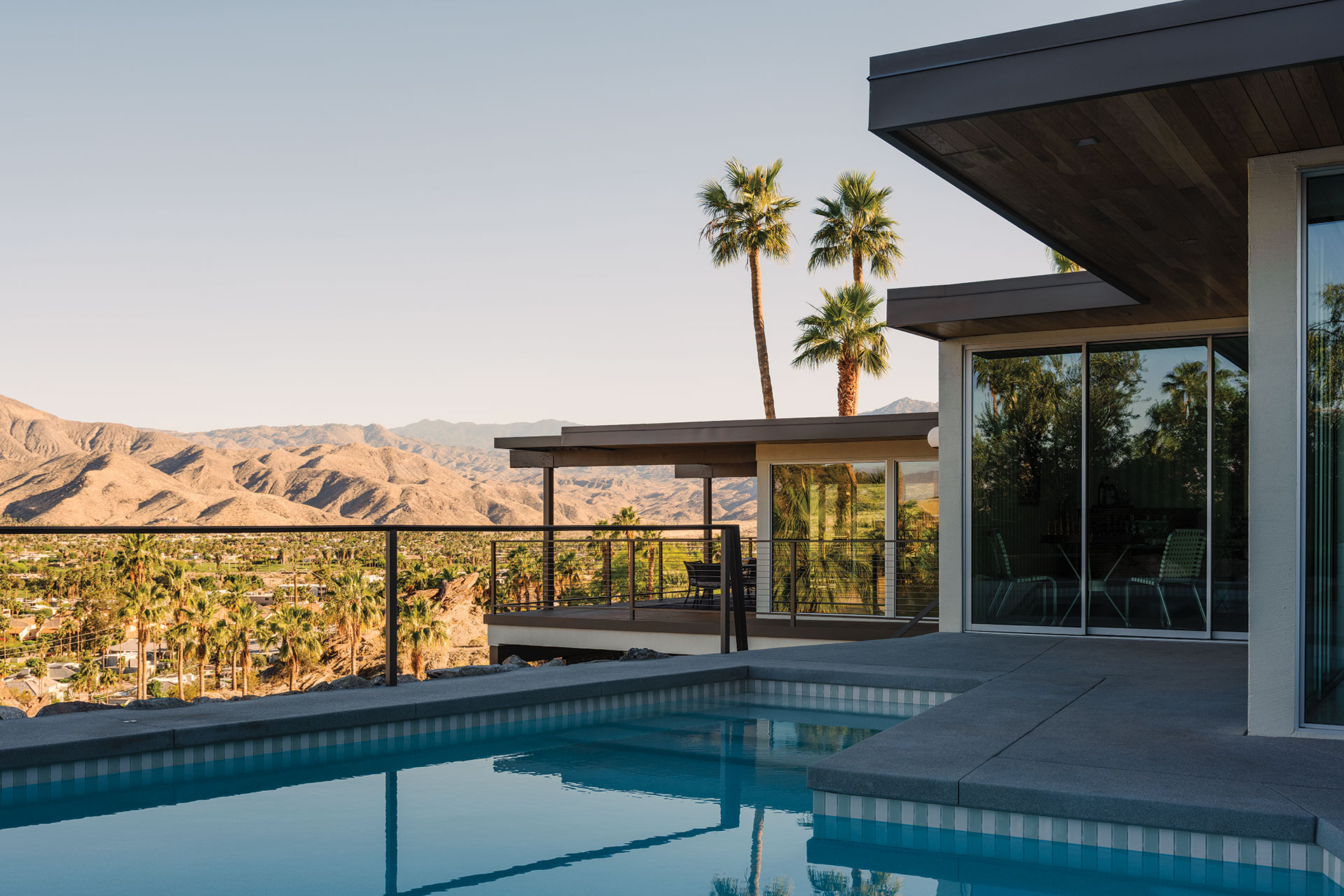
A bamboo bar room acts as a transition between indoors and out. Turk imagined it as the interior of a beach cabana, and its striped wallpaper gives the space continuity. The stripes visually extend into the exterior tongue and groove oak overhangs, while alternating colors of tile at the pool’s waterline echo the same pattern. “I had been to William Cody’s family home in Palm Springs, I saw the ceiling in that house, and I was like, ‘You know, it makes it feel warmer.’ So we ended up doing it on the outside decks,” she says. She added a plaster bench around the curve of the pool for soaking and restored the streaming water jets to create more of a party vibe. The cheery sunburst pattern from the breeze blocks is reflected in the Schumacher indoor-outdoor fabric Turk designed for the pool furniture and umbrellas.
For all its design intelligence, Soleil House does not take itself too seriously. Swinging chairs hang against the view on the front deck. “Who doesn’t want to sit in a swinging chair?” she says, laughing. Soleil House is a stunning renovation, but it also proposes a fuller vision of her brand as a lived experience that could inspire a hotel venture, she hints. But for now, Palm Springs has another revived midcentury gem. And appropriately, it is the architecturally significant photo backdrop for a new fashion collection, Trina Turk’s Summer Soleil.
Feature image: Trina Turk x Santa Barbara Umbrellas and Trina Turk x Schumacher fabric-covered loungers bring the home’s resort feel outside to the pool deck.
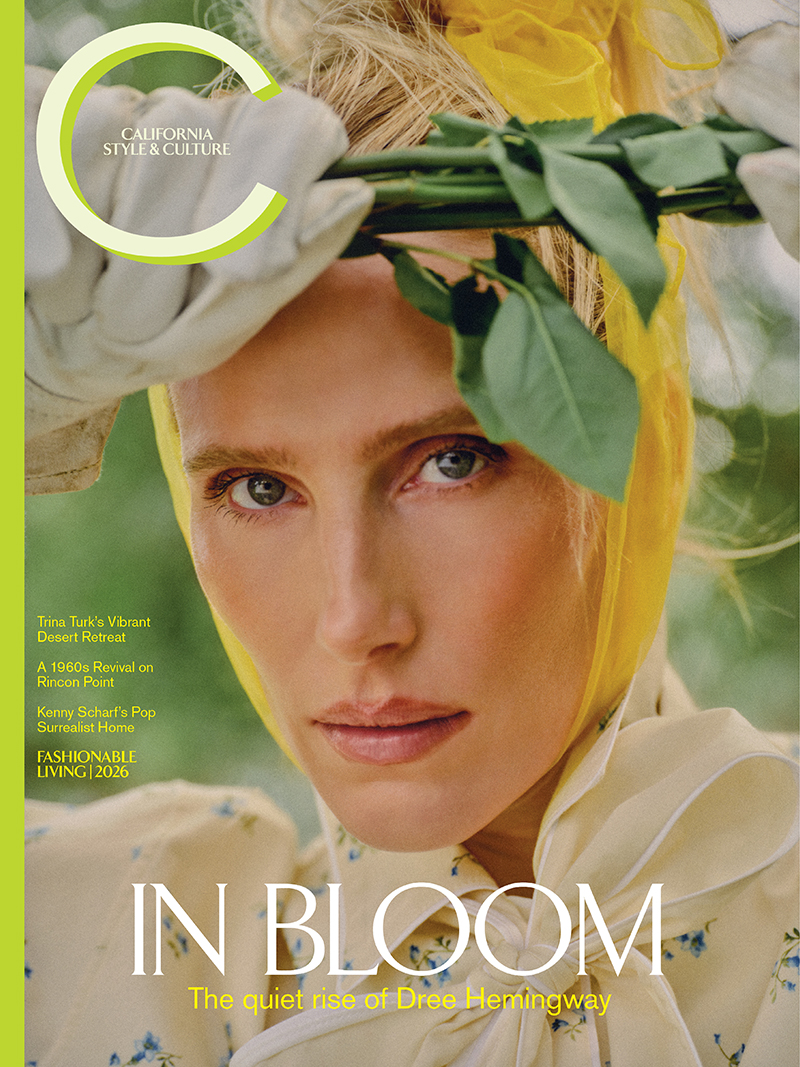
This story originally appeared in the Fashionable Living 2026 issue of C Magazine.
Discover more DESIGN news.
See the story in our digital edition