In the footsteps of California design giants like JB Blunk, the artist carves out benches, chairs, and abstract forms in his Claremont studio
Words by CHRISTINE LENNON
Photography by JUSTIN CHUNG
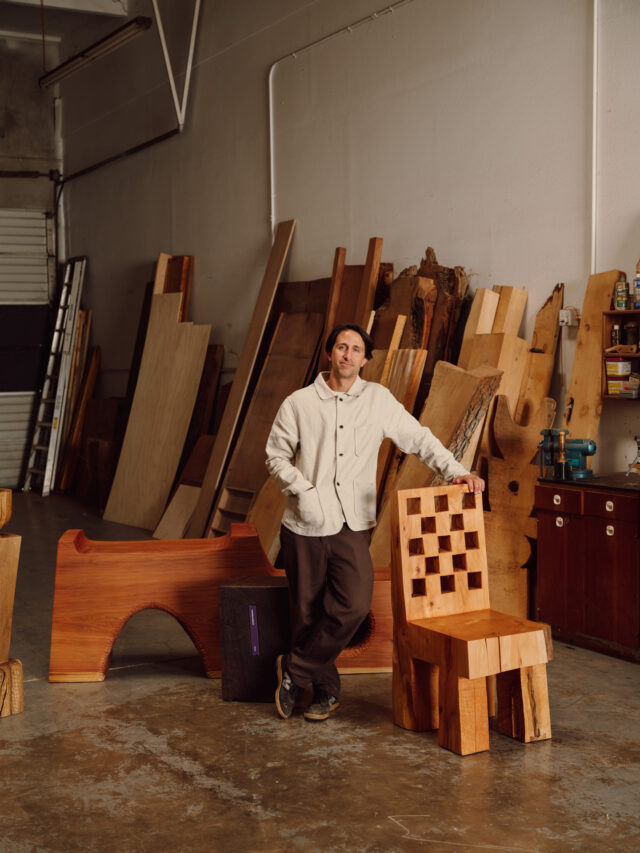
Vince Skelly was “timid” around power tools before he tried his hand at large-scale carved-wood sculptures. As a child of two painters who worked in academia, he was surrounded by infinite materials for experimentation and play in his family home in Claremont. But Skelly took a more practical detour on his career path: He went to San Francisco to study graphic design and was working, mostly happily, in Portland, Oregon. Then he had a change of heart.
“I never wanted to do art as a profession, so I went into graphic design to support myself,” Skelly says. “Then, in 2011, I found Handcrafted Modern: At Home With Mid-Century Designers, a book by Leslie Williamson, and saw the feature on JB Blunk.”
Discovering Blunk’s rough-hewn aesthetic flipped a switch, especially the way he used fallen trees and stumps from the Northern California forests to build his own home in Inverness and blurred the line between sculpture and furniture with artful stools and tables. Skelly was inspired to experiment with small carved-wood objects in his garage, striving to imitate the deceptively simple geometry achieved by artists like Blunk, Constantin Brâncuşi, and Isamu Noguchi. To level up to larger sculptures, Skelly dove into a two-day course in chain saw carving.
“It was one of those kitschy roadside-attraction places where they had 200 bears carved into logs,” he says. “I went with pictures of the simple forms I was interested in, but the teacher said we needed to focus on the eagle’s talons.”
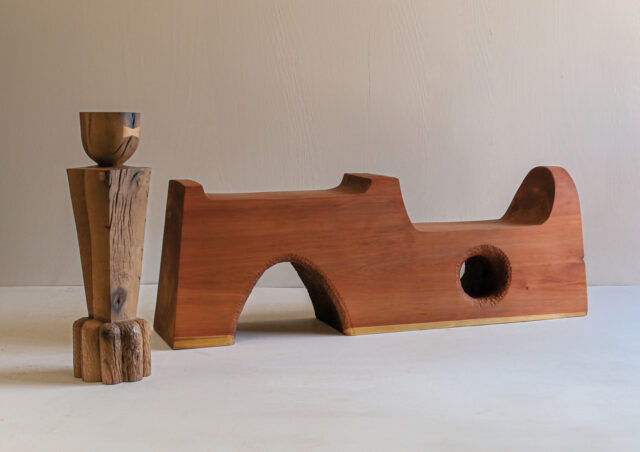
He came away with a couple of “pretty good” bears of his own, as well as a new appreciation for the unique properties and differences between the varieties of trees that are harvested across California. He spent 10 years honing his craft.
“I talked to an arborist, and he taught me about kiln drying to kill the bugs in the wood. I would rough out the form with a chain saw and throw it in the kiln, sand, oil, and finish it from there,” he says. “For the first year, I gave myself lessons as if I were in a sculpture class, making a sphere, an hourglass, then a three-legged stool. I evolved from there, looking at more ancient references, like Dolmens and other megalithic structures. There was this cool thing happening between megalithic design and mid-century modern design.”
A friend in Portland owned Lowell, a home design and vintage shop, where Skelly sold a handful of his early hourglass stools. That’s where his work caught the eye of illustrator Lisa Congdon. She invited him to participate in a gallery show, some favorable press followed, and the momentum picked up.
Today, 80 percent of Skelly’s work is direct commission to clients, primarily through interior designers like Commune and Kelly Behun. A custom piece was commissioned for the Burberry store on Rodeo Drive. The rest is designated for galleries, like TIWA, where Skelly says he can experiment with new forms that help his practice evolve.
“There’s more emphasis on an object when it’s made by hand and one-off.”
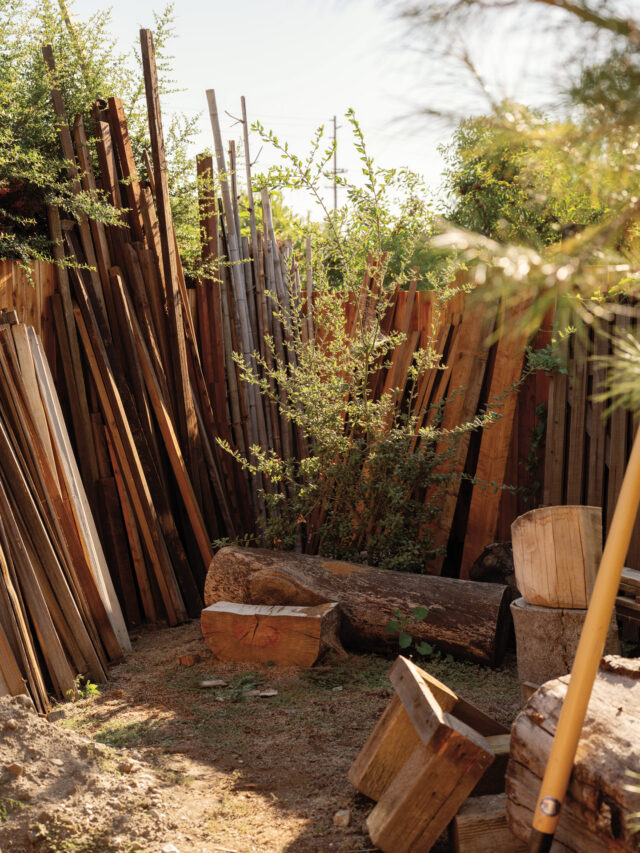
He sources his wood from trees that have become dangerous and have to be removed, or he visits fallen wood yards, like Street Tree Revival in Anaheim, where giant logs are organized and neatly stacked by species and size. He transports the wood he selects in the back of his truck to his studio near his childhood home in Claremont. Skelly and his wife, Jessie, returned to their shared hometown to live and work and raise their children — a 2-year-old daughter and a baby due later this year.
Starting with a chain saw, Skelly works reductively, carving out chairs, benches, and abstract forms from a single piece of wood. Once he has determined a rough shape, influenced by the natural knots and grain in the wood, he moves on to smaller tools like a mallet and chisel to refine the form. He sands pieces by hand and dries them in a kiln off-site.
“In Southern California, a lot of the wood is 50 to 100 years old, but old-growth redwood is almost like a different species than second-growth redwood,” he says. “Trees that were planted 1,500 years ago, or 500 years ago, grew in a totally different climate. You just can’t grow that anymore.”
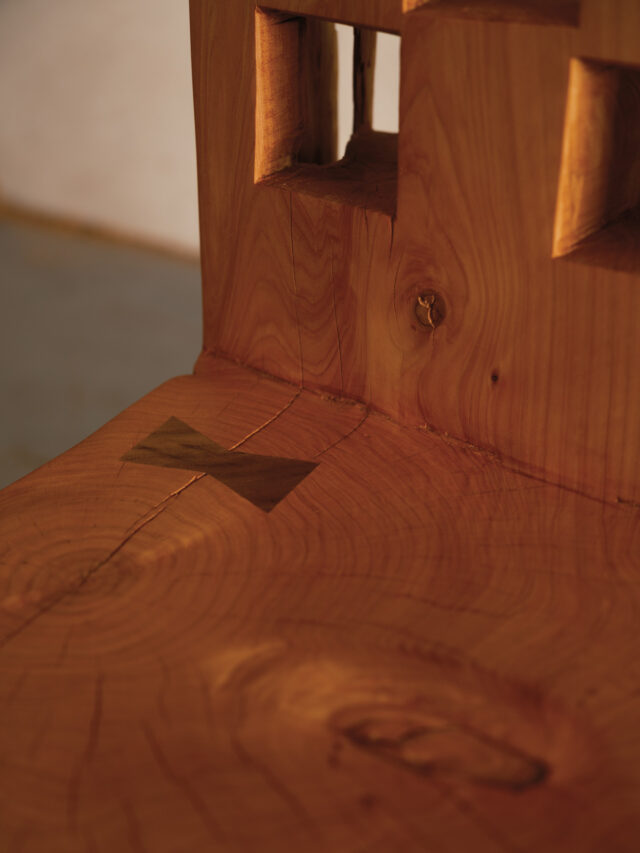
Recently, Skelly was invited to participate in a group show at the Craft Contemporary museum in Los Angeles. Material Curiosity by Design: Evelyn and Jerome Ackerman, open until May 2026, highlights the influential mid-century modern polymaths’ work in ceramics, textiles, mosaics, and woodwork. The exhibit frames the Ackermans’ modernist legacy alongside a new generation of artists — Porfirio Gutiérrez, Jolie Ngo, and Skelly — whose practices are rooted in “material exploration” and tradition. Skelly will showcase four new large-scale carved wooden works: a bench, a chair, an offering bowl, and his first bookcase.
“In February and March, I’m doing a residency at the museum, re-creating my studio on their entire second floor,” he says. “I’ll be working on small pieces on-site one day a week.” Skelly’s work, which blurs the line among furniture, art, and artifact, appeals to collectors who appreciate its one-of-a-kind nature along with its functional elements.
“There’s more emphasis on an object when it’s made by hand and a one-off,” he says. “The world has gotten so fast, and everything is so accessible — from information to commodities — that when you see a handmade thing and bring it into your home, it changes the mood and the character of the space.”
Skelly is aware that he’s continuing an artistic legacy that’s unique to California, and that he’s only one generation removed from his heroes. “I met JB Blunk’s daughter, Mariah, at an opening and told her, ‘Your dad’s work changed my life.’ He is the person who has influenced me most,” he says. And despite his initial misgivings, Skelly has carved his way into California’s artistic legacy. vinceskelly.com.
This story originally appeared in the Winter 2025 issue of C Magazine.
Discover more STYLE news.
See the story in our digital edition